Tuesday, 24 January 2012

Alarming realisation about most people

I live in a world where I assume that everybody thinks a bit like me. I assume that the think most people crave in their meagre little lives is a sense of freedom to experiment, and an opportunity to be creative. To fix the things that are broken.

I am currently suffering from "roll out-itis" - my business is "standardising" everything.

In recent months I have struggled and fought against this, because in my view of the world, this is wrong.

I guess I also though that it was a waste of effort. Whether or not you believe that people should be free to improve their own working processes, it has been proven by giants such as Toyota that "rolling out" something that works in one location without consideration of cultural and political differences will fail.

However, yesterday two things happened to change my view point a little. The first was the level of enthusiasm for a 90 minute training program which is being rolled out across our business (step one of standardisation). The second is the level of comfort that our exec team gained from knowing they were following a proscribed process, and that they could not deviate.

Slowly it dawns on me that my way of thinking is unusual. Most people are happier following.

If I use an analogy of another group of animals that are notoriously good at following - a flock of sheep - that makes me a wild dog in their midst. And despite the fact that my intentions are honourable - that I am trying to stop the sheep dogs from guiding them into a wilderness - the leaders in the organisation just see my behaviour as that of a wild dog.

So, not entirely sure what to do with this revelation.

Saturday, 7 January 2012

What is it I do when I do what I do?

This recursive question is one of the reasons (honestly, it might be more of an excuse!) that I have stopped studying for a month!

So, let's pick it to pieces...

What do I do?

Well, let's consider when I go into action on a supply issue in my job. What I dofirst is to try to get clarity of the supply side of the issue. Firstly, I try to get information about what has caused the issue, what is the severity of the issue, what are the things that have to happen to solve the issue, and what are the things that could happen (or not happen) that are outside of our control that could prevent us solving the issue.

After this, I check my understanding with someone I trust... then I communicate to the commercial team what I think is likely to happen, but also what could happen (good and bad).

I then drive the commercial team to mitigate the issue in some way (alternative product, reduce demand, move demand, stop a launch...)

Then I review periodically to make sure everything is happening as expected. If something is different, I go back to the start and reiterate the process.

What is it I do when I do this?

Normally, I enter a situation like this with a feeling that the full supply issue is not understood. I have found in the past that people misrepresent the truth. Sometimes because they don't understand, and sometimes because the truth is not something they want to admit to. Experience has taught me that the communication to the commercial teams must be accurate, and that credibility is eroded if corrections are needed after the initial communication. Therefore I spend much more time understanding this part of the problem than others think I need to.

I often talk about needing to "give people time to move through denial". (I think this is change management theory) I think this is also a process I go through in this "understanding" phase. My experience is that other people also need time and space, like me, to be sure that the information is correct. I think part of this is emotional acceptance.

In addition, I talk about needing to understand, at least loosely, what the cause of the issue is. In my head, I am already building a process to avoid this in the future - even though that is not the key issue at this point in the process. I would like to be doing this more systemically - Senge talks about "After Action Reviews" - which are reviews of observations during action.

Checking my assuptions with a trusted person is not just about checking facts, it is also a process of testing the story, and being able to tell it without blame. (Knowing why a problem has occured can lead to laziness - and one thing I try to avoid is apportioning any blame during the crisis management - as it is counterproductive to the team - mostly, if the cause was a person, the person is part of the "fix it" team as well).

Communication to the commercial team can take time. They have to be brought through the change management process from "the world is good" to "the world is lousy". Also, there is often desire to NOT communicate bad news to everyone in the organisation. This can be quite a delicate operation.

Encouraging the team to reach a mitigated action plan - particularly where there is more than one commercial group impacted can also take time. In addition, they don't always reach an accomodation that I am happy with (and in this situation, the best that can be hoped for is an accomodation, there is rarely a solution). When this happens, I find it difficult to refrain from arguing - but my role is one of facilitator, not dths.ecision maker.

Finally, the process of course checking and correcting requires a very systematic approach. This is not playing to my strenghs. I have learned over the years that this part of the process is better managed by somebody other than me! So my final act in this type of situation is to hand over the reins to somebody else.

Tuesday, 6 December 2011

Notes on Chapter 10 - Systems Practice

Pg 243
Users of systemic inquiry must be capable of:
  1. Understanding situations in context (now and past)
  2. Appreciating multiple stakeholders and perspectives
  3. Addressing and clarifying questions of purpose
  4. Distinguishing between how & why
  5. Facilitating action which is purposeful and systematically desirable / culturally feasible
  6. Orchestrate understanding - co-evolutionary dynamics
  7. Institutionalising use of approach
Pg 244
Systemic inquiry is a meta-platform for project or program management

Pg 245
Churchman defined inquiry as an activity which produces knowledge
Churchman recognised the central role of the practitioner in any process of inquiry

Pg 246
Systemic inquiry = device for enabling systems practice that acknowledges and addresses uncertainty.

Pg 248
Critical activity in conducting a systemic inquiry
  1. Make sense of...
  2. Tease out... accomodations
  3. Define possible actions
Pg 249
Social learning is one or more of the following processes:
  1. Convergence of goals, criteria and knowledge leading to awareness of mutual expectations
  2. Co-creation of knowledge which provides insight into the history of and the means required to transform a situation
  3. Change in behaviour resulting from understanding gained through doing
  4. Emergent property of the process of transforming a situation
I want to create a social learning culture across MD&D plan - but I don't know how to do this in a virtual environment... has anyone ever achieved this?

Pg 255
Workshop design
Part 1 Expose differences in understanding amongst participants
Part 2 Define the nature of the issues (reflection on part 1)
Part 3 Activity models to enable participants to gain a more systemic understanding
Part 4 Proposals for next steps and review of learning / evaluation

Pg 257/8
Persyst was a collaboration between personnel and the systems department at OU... carried out virtually.
"Ironically, the act of mainstreaming commissioned persyst to the margins"
I wonder why?

My attempt at a narrative about a sticky situation

The aim of my business (like most I guess) is profitability. I work in the supply chain, and once the hygiene factor of product availability has been met, we are only able to impact profitability through reducing costs.

This has led to the implementation of a concept of "cost improvement projects" or CIPs. In the early days, these were genuine attempts to remove unnecessary costs from the business. The projects chosen were true opportunities to reduce cost, and were in addition to any business planning. this meant, if they succeeded, that was good news, and if they failed, well, it was not the end of the world.

Since then, the idea of CIPs has become quite a divisive instrument in the business.

Our organisation is structured along functional lines - which leaves us vulnerable to silo thinking (or smoke stacks in the olden, non American days!) where each function is really only concerned with achieving their own targets. This structure is relatively new, so there is a strong desire on the part of the functional leadership to prove that the structure is a good one, and that it is driving tangible benefits to the business... And that each functional head is better than their colleagues...

So, back to the CIPs. THey started life as voluntary incremental projects, which would improve the costs beyond the business plan commitment. CIPs have now become an integrated part of the business planning process.

As a functional cost centre owner, I submit my best estimate of how much it will cost to run the department for the following year. Once that has been submitted, an incremental CIPs target is handed out to each cost centre.

At this point, all business leaders clamour to stake a claim for incremental projects, that may even not belong in their remit, in order to meet their CIPs target.

High levels of resource and effort is expended in arguing about who owns each CIP project. In addition, predictably, CIPs tend to be contradictory (as an example, this year there are two initiatives - one to reduce transportation costs, which will increase leadtimes.... and another to reduce inventory in the warehouses...)

This is now at the extreme point that a department has been established to "manage the CIPs list". One of their primary functions is to arbitrate CIPs ownership claims from the various functions.

Perhaps the most disappointing part of this sticky situation is that even after all that effort, it is virtually impossible to hold anybody accountable for delivery of the promised saving which often does not materialise. This means that the overall profitability of the business is impacted. Sadly, this then increases the pressure on finding more CIPs and puts more strain on the inter-functional relationships.

Monday, 31 October 2011

SAQ 1.1 What elements combine to create a practice performance?

There are four elements that are present in a practice performance.

The first is the practitioner (or the person...) This is the person making the intervention which is called the "practice performance". This can be at two levels - the person thinking about the practice may or may not be the same person as the person engaged in the practice.

The second element is the situation that the practitioner engages with.

Thirdly, the practitioner views the situation via a framework of knowledge and assumptions about the situation.

Finally, the practitioner chooses a method to apply to the situation.

Walking as a practice - Activity 1.10

OK - if you are reading this (and lord knows why you would be) I apologise. This is an academic activity - and in addition is also probably not anatomically correct.

If you are looking for intelligent comment on systems... this is really not the day (and if you are looking for a serious analysis of how we walk, this will never be the place!)

So, my left heel touches the floor, and as the weight transfers onto my left foot from my right, the left foot rolls until heel, ball and outer edge of the foot are all in contact with the floor. as this happens the left knee bends slightly.

As this weight transfer takes place, there is a swivel in the hips - which I think is caused by the muscles in my stomach.

Once the weight has been totally transfered, the left leg straightens a little and the right leg bends, causing the heel of the right foot to roll up.

As the right foot rolls, and the ball of the foot leaves the floor, the right knee bends, and there is another hip swivel (again through stomach muscles tensing) which kicks the right foot forward.

At this point my slipper fell off - but I think you have the idea!

Wednesday, 26 October 2011

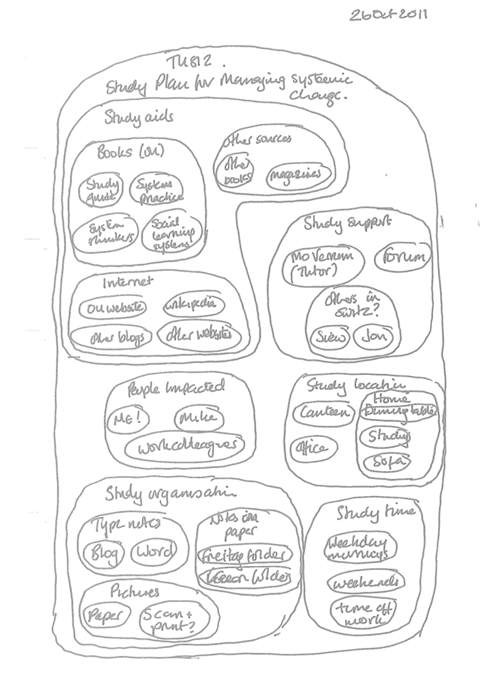
My very first systems map


OK, so prior to the activity to create a blog, I had to create a systems map of the course I am studying (TU812 with the Open University)


To be honest - this blog post is more of an experiment on how to share pictures. Seems to work ok I think.


I might do more of this!